SWIM LESSONS
At the YMCA, we believe everyone should learn to swim. It's a great way to stay in shape, learn water safety, and develop a lifetime of fun activities.
A few things to keep in mind to get the most out of swim lessons: Swimming skills are progressive and build on each other, it's important to pick the right level for yourself or your child. Usually it takes more than one session before a child or an adult is comfortable in the water. Swim lessons are non-competitive, so don't feel pressured to push higher if not ready. It's normal (and even advised) to take several sessions within the same level.
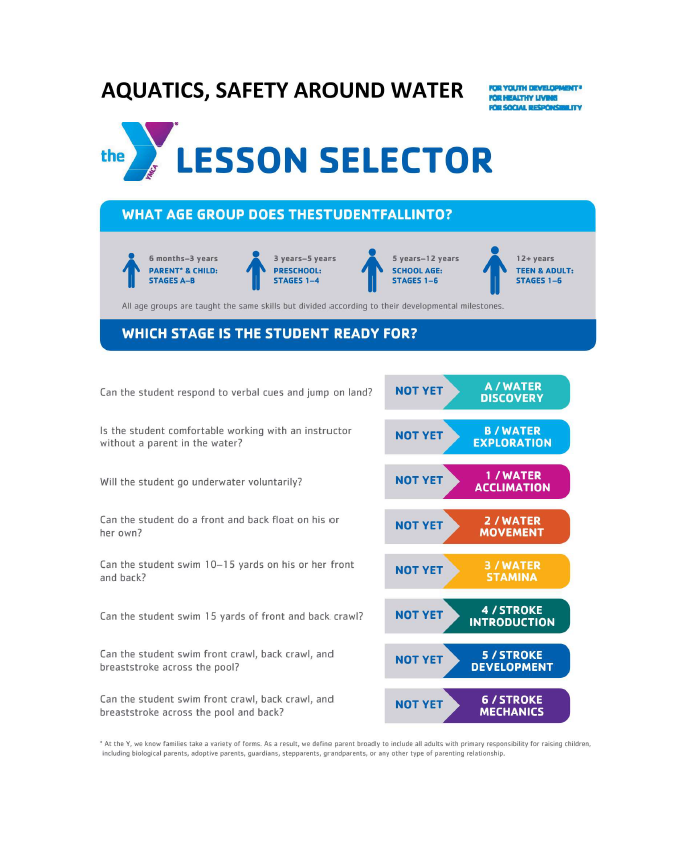
Not sure what is the best swim level to choose for your child? Use our Lesson Selector Guide or visit our Member Services Desk to help you choose the right level.
PREPARING FOR SWIM LESSONS AND ATTENDING SWIM LESSONS:
Pictures, videotaping, or cell phone use are NOT ALLOWED on the pool deck or from the Lobby viewing area. Please respect the privacy of our families and members.
-
Children under the age of 9 need an adult, 18 years of age or older, during drop off, pick up, and MUST remain in the viewing area in the lobby during class.
-
If a child under 9 years of age needs to use the bathroom during class the parent will need to escort their child and bring them back to their class.
-
We recommend all children under the age of 9 use the bathroom before class.
-
Diapers are not permitted in the pool. Children who are not potty trained are required to wear a waterproof diaper or rubber pants.
-
Arrive to the YMCA and scan in using your membership tag at at the Front Desk
-
Arrive to class 5 minutes prior to the start time
-
A Lifeguard or Swim Instructor will let you into the pool deck when it is time for your scheduled lesson. Please wait in the WET HALLWAY location until you are called for your lesson.
-
Youth Locker Rooms and Individual Family Changing Rooms can be found on the first floor of the YMCA.
-
Enter the swimming pool though our ‘WET HALLWAY’ doors.
-
Take a cleansing shower in the WET HALLWAY prior to entering the pool.
-
Some lessons occur in the Therapy Pool. Some lessons occur in the Lap Pool. Typically all Preschool lessons and Parent/Child Swim Swim Starter Classes occur in the Therapy Pool.
-
Goggles are recommended for all levels.
-
Our pool area temperatures are warmer than the hallways and locker rooms so towels or robes are recommended especially in colder months.
PEEK WEEK
-
During Peek Week, parents may observe their child’s swim class on the pool deck.
-
Photos and videos are allowed during Peek Week only.
-
Peek week is typically the 2nd to last week of the session.
-
Swimmer’s Progress Reports are handed out by instructors on these days
CANCELLATIONS & MAKE UP CLASSES
-
Due to the ratio of instructors to swimmers, make up classes are not feasible or allowed.
-
If a class is cancelled by the YMCA Aquatics department for any reason (ie. pool closure, water chemical issues, thunder & lightening) the cost of the missed class will be refunded to your account at the end of the session.
POOL RULES
Safe Pools Have Rules
LIFEGUARD SAFETY
1. Lifeguards have the final say on all safety and pool issues, respect their decision.
2. Lifeguards have the discretion to mandate a PFD on a swimmer or require a swim test of any swimmer.
3. When the whistle blows, look to the lifeguard for directions. If you hear 1 long whistle blast, exit the pool.
POOL SAFETY
Parents/Guardians are responsible for their children’s behavior and for supervising their children while swimming.
1. ALL children 7 & under, regardless of ability, must have an adult in the water with them, within arm’s reach.
2. All swimmers 9 & under must be accompanied in the pool area, at all times, by a responsible person that is at least 18 years of age.
3. Children 10 & under or shorter than 50”, who have not passed the deep end swim test, are required to wear a U.S Coast Guard approved PFD. (No inflatables: water wings, swim rings).
4. Inflatables, swim bubbles, and any non-Coast Guard approved PDFs are not allowed in the pool.
5. Coast Guard approved PFD’s are to be used in the shallow end only.
6. Children 7-17 years of age must pass a swim test before they are permitted to enter the deep end. Lifeguard can retest any child at any time.
7. Diving is permitted only in areas of the pool that are 9 feet or deeper.
8. Swimmers must enter water from side facing forward—no flips, spin, or back jumps/dives.
9. Horseplay and rough-housing are not allowed in any area.
10. No prolonged underwater swimming or breath holding.
11. If thunder is heard or a lightning strike is observed by Lifeguards, the pool will be cleared. If possible, the pool will reopen 30 minutes after the last observed thunder or lightning strike.
12. YMCA staff may close the pool at any time for safety reason, including but not limited to: Chemical Imbalance, Mechanical Issue, Water Clarity, Pool Contamination
POOL HYGIENE
1. No person with a communicable disease is allowed to use the pool.
2. Showering before entering the pool is required by Massachusetts State Law.
3. Proper swim attire must be worn at all times.
4. Infants and toddlers not potty trained must wear a swim diaper.
5. Persons with bandages, blisters, or open wounds are prohibited from using the pool.
POOL ETIQUETTE
1. Photographs, video, live feed, etc...are not permitted in the pool on the pool decks
2. No glass, food, or drink in the pool area.
3. Lane lines are not to be used as support by swimmers.
4. Lap swim lanes are for lap swim only.
5. Lap swimmers must share lane space, and if necessary, circle swim.
Swim Classes
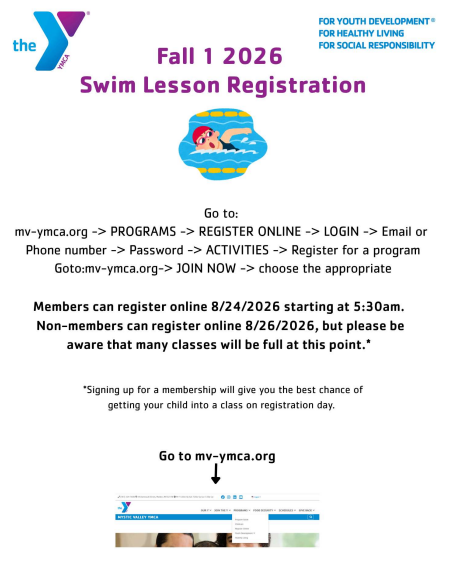
Swim Classes meet once a week for 30 minutes.
Parent & Child Swim Starters
This class allows a parent and child to bond while giving the child a positive first experience in the water. Parents learn cues and hold onto teach their children basic water skills. Fundamentals are introduced by songs, games, and activities.
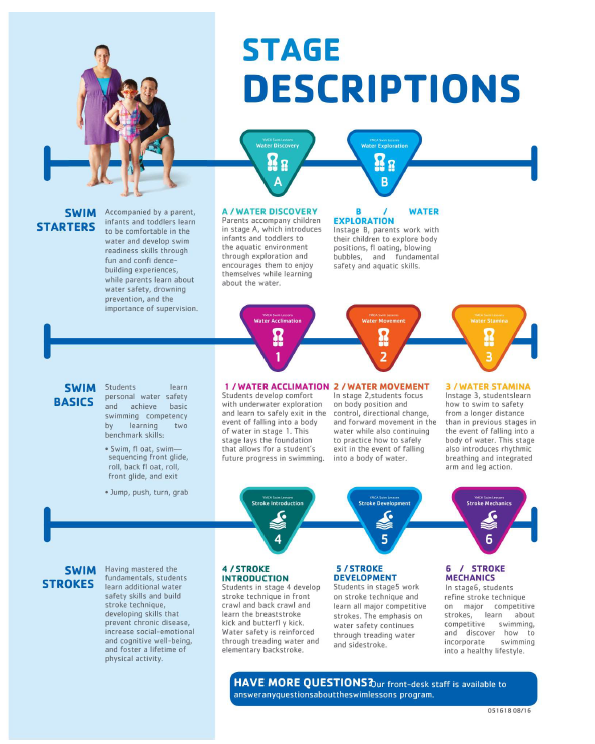
Accompanied by a parent or guardian, infants and toddlers learn to be comfortable in the water and develop swim readiness skills through fun and confidence building experiences, while parents learn about water safety, drowning prevention, and the importance of supervision.
A/WATER DISCOVERY (6 months - 18 months) Parents accompany children in stage A, which introduces infants and toddlers to the aquatic environment through exploration and encourages them to enjoy themselves while learning about the water.
B/WATER EXPLORATION (18 months - 3 y.o) In stage B, parents work with their children to explore body positions, floating, blowing bubbles, and fundamental safety and aquatic skills.
*PARENT CHILD A & B MAY BE COMBINED DURING SOME SESSIONS
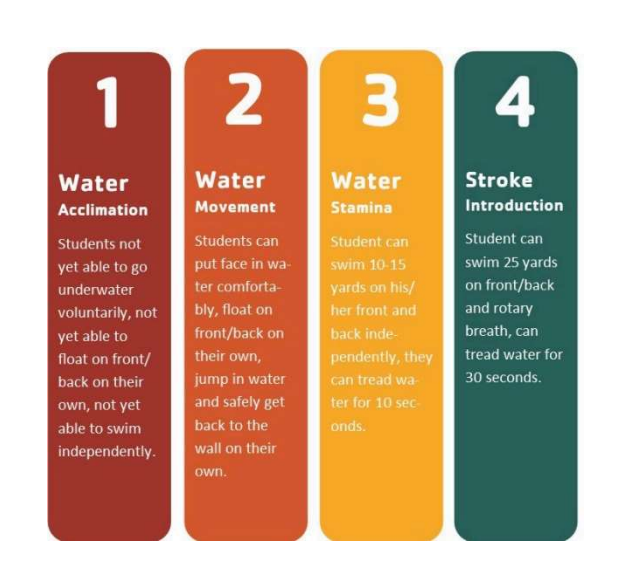
PRESCHOOL STAGES 1-4 are for children aged 3 through 5. Classes are kept small for a focused approach. Swimmers must show the ability to complete all skills described below at each level before moving on to the next level.
Preschool Program ,
1/ PRESCHOOL WATER ACCLIMATION
In this class, children attend without their parents in the water to help boost confidence, and develop safe behavior around water. These classes focus on teaching basic paddling, kicking, and pool safety, while increasing comfort levels, especially while putting mouth, face, and eyes into the water.
Students develop comfort with underwater exploration and learn to safely exit in the event of falling into a body of water in WATER ACCLIMATION. This stage lays the foundation that allows for a student’s future progress in swimming. It is normal and recommended for children to spend several swim lesson sessions at this level.
Requirements to move to Stage 2:
-Able to go underwater voluntarily
-Able to Exit the Pool Independently
-Able to FLOAT on front & back with assistance
-Able to swim 10 feet with assistance
2 / PRESCHOOL WATER MOVEMENT
Water movement swimmers are advanced beginners. This level reinforces the skills learned in Water Acclimation. Children learn to paddle and kick on the front and back without support, build endurance, and will learn to jump into water without assistance students focus on body position and control, directional change, and forward movement in the water while also continuing to practice how to safely exit in the event of falling into a body of water. Swimmers at this level are comfortable in the water and can swim short distances without support. It is normal and recommended for children to spend several swim lesson sessions at this level.
Requirements to move to stage 3:
-Swim 10 feet on their front & back independently
-Able to tread water for 10 seconds
3/ PRESCHOOL WATER STAMINA
Water Stamina classes are for intermediate swimmers who can swim 30 feet on their own with no assistance. They will learn to swim independently, to float and tread water without assistance, and begin to travel farther distances in the pool while working on breath control and endurance. In stage 3, students learn how to swim to safety from a longer distance than in previous stages in the event of falling into a body of water. This stage also introduces rhythmic breathing and integrated arm and leg action. Endurance is the key principle. It is common for swimmers to take several sessions of this level.
Requirements to move to Stage 4:
-Able to swim 15 yards on front & back
-Can tread water for 30 seconds
-Able to submerge and retrieve object in chest-deep water
4/PRESCHOOL STROKE INTRODUCTION
These classes are for children to build on skills learned in Water Acclimation & Movement classes. They're introduced to the four major swim strokes and learn to float unassisted. Swimmers at this level will swim full lengths of the pool and will be introduced to diving.
Students in STROKE INTRODUCTION develop stroke technique in front crawl and back crawl and learn the breaststroke kick and butterfly kick. Water safety is reinforced through treading water and elementary backstroke It is common for swimmers to take several sessions of this level.
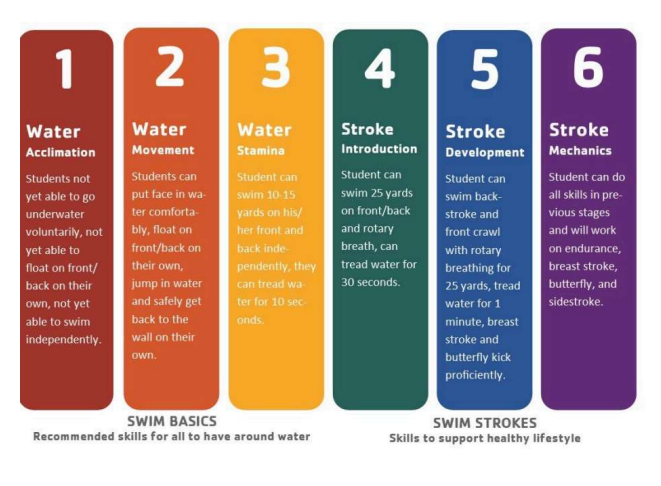
YOUTH STAGES 1-6 are for Children ages 6-12. Swimmers must show the ability to complete all skills described below at each level before moving on to the next level.
1/ YOUTH WATER ACCLIMATION
In this class, children attend without their parents in the water to help boost confidence, and develop safe behavior around water. These classes focus on teaching basic paddling, kicking, and pool safety, while increasing comfort levels, especially while putting mouth, face, and eyes into the water.
Students develop comfort with underwater exploration and learn to safely exit in the event of falling into a body of water in WATER ACCLIMATION. This stage lays the foundation that allows for a student’s future progress in swimming.
Requirements to move to Stage 2:
-Able to go underwater voluntarily
-Able to Exit the Pool Independently
-Able to FLOAT on front & back with assistance
-Able to swim 10 feet with assistance
2 / YOUTH WATER MOVEMENT
Water movement swimmers are advanced beginners. This level reinforces the skills learned in Water Acclimation. Children learn to paddle and kick on the front and back without support, build endurance, and will learn to jump into water without assistance. Students focus on body position and control, directional change, and forward movement in the water while also continuing to practice how to safely exit in the event of falling into a body of water.
Swimmers at this level are comfortable in the water and can swim short distances without support. It is normal and recommended for children to spend several swim lesson sessions at this level.
Requirements to move to stage 3:
-Swim 10-15 yards on their front & back independently
-Able to tread water for 10 seconds
3// YOUTH WATER STAMINA
Water Stamina classes are for intermediate swimmers who can swim 30 feet on their own with no assistance. They will learn to swim independently, to float and tread water without assistance, and begin to travel farther distances in the pool while working on breath control and endurance. In stage 3, students learn how to swim to safety from a longer distance than in previous stages in the event of falling into a body of water. This stage also introduces rhythmic breathing and integrated arm and leg action. Endurance is the key principle. It is normal and recommended for children to spend several swim lesson sessions at this level.
Requirements to move to Stage 4:
-Able to swim 25 yards on front & back
-Can tread water for 30 seconds
-Able to submerge and retrieve object in chest-deep water
4/ YOUTH STROKE INTRODUCTION
These classes are for children to build on skills learned in Water Acclimation & Movement classes. They're introduced to the four major swim strokes and learn to float unassisted. Swimmers at this level will swim full lengths of the pool and will be introduced to diving.
Students in STROKE INTRODUCTION develop stroke technique in front crawl and back crawl and learn the breaststroke kick and butterfly kick. Water safety is reinforced through treading water and elementary backstroke It is common for swimmers to take several sessions of this level.
Requirements to move to Stage 5:
-Able to swim backstroke and front crawl with rotary breathing for 25 yards
-Able to tread water for 1 minute
-Breaststroke and Butterfly kick proficiently
5/ YOUTH STROKE DEVELOPMENT
Stroke Development is an intermediate level that focuses on building endurance, stroke development, and water safety skills. This level focuses on refining strokes and diving skills, focuses on pool and personal safety and introduces rescue skills. Students in stage 5 work on stroke technique and learn all 4 major competitive strokes. The emphasis on water safety continues through treading water and sidestroke.
Requirements to move to Stage 6:
-Student is able to swim 25 yards of freestyle, backstroke, and breaststroke, and butterfly.
6/ YOUTH STROKE MECHANICS
In stage 6, students refine stroke technique on all major competitive strokes, learn about competitive swimming, and discover how to incorporate swimming into a healthy lifestyle. Stroke Mechanics is an advanced level that focuses on building endurance, stroke development, and preparing participants for swim league. Participants must be able to swim 50 yards of freestyle, backstroke, and breaststroke and 25 yards of butterfly.
MALDEN CROCS SWIM TEAM
Swim team try-outs are held periodically, typically in Summer & Fall based on available spaces in the program. Additional info about the Crocs Swim Team can be found HERE (click here)
TEEN SWIM LESSONS
We welcome teens of all ages and skill levels to participate in our programs.
Teens Ages 13 - 15 will be placed in Youth Classes.
Teens ages 16 - 18 may be placed in Youth or Adult Classes depending on the appropriate stage.
Adult Lessons
Currently, the Mystic Valley YMCA offers beginner and intermediate level classes for adult swimmers.
Adult Beginner: This is an introductory class for adults who have minimal to no swimming experience. The focus of the class will be on comfort in the water, submersion, front floats and back floats, as well as how to make forward movement in the water.
Adult Intermediate: Swimmers in this class will be introduced to proper breathing and stroke techniques while building confidence in and around deep water, combination skills, safety and endurance.
Adaptive Aquatics
Adaptive Swim Lessons are geared towards students with Special Needs including those with cognitive, developmental, neurological and/or physical disabilities. These challenges may include:
• Autism Spectrum Disorder
• Attention Deficit Hyperactivity Disorder (ADHD)
• Cerebral Palsy
• Down Syndrome
• Visual, Hearing or Speech Impairments
• Learning Disabilities
• Emotional Disturbances
• Paralysis
Each lesson is customized to the swimmer's needs, with the focus being helping the swimmer be safe and comfortable in and around the water rather than following standardized levels that require specific skills for class levels or stage promotions. Instructors are certified in the Swim Whisperers Program. Each student enrolled must have an adult caregiver 18 years or older in the water assisting the students with the skills customized for them by the instructor.
Demand for the Adaptive program currently exceeds our capacity, but we are committed to growing and reaching as many participants as possible. Complete this form to join the interest list, we will contact you as spots become available.
Private Lessons
Private and semi-private lessons are occasionally offered to swimmers of all ages and abilities. Swimmers are matched with instructors based on availability and swimmer’s needs.
If you are interested in private lessons, complete this form, we will contact you when a space is available.





Frequently Asked Questions
JOIN THE Y!
The Y is a cause for strengthening community. That’s why we’re here working with you every day, making sure that you, your family and community have the resources and support you need to belong, grow and thrive. With a focus on developing the potential of kids, improving individual health and well-being, and giving back and supporting our neighbors, your membership will bring about meaningful change not just within yourself, but in your community, too. You don’t just join the Y—you belong here.